

In this article, we will learn about, how Maxwell changed our understanding of light. He showed electricity, magnetism, and light are interconnected and derived a set of equation called Maxwell’s equation that predicted Electromagnetic waves.
Let us first look at Newton and Huygen’s approach to the description of light:
What is Newton’s Corpuscular theory of light?
This theory describes light as a stream of tiny elastic and massless particles, called corpuscular. These corpuscular are emitted by the light source and travel in straight lines at high speeds through space. In short, he supported the particle nature of light.
What is Huygen’s wave theory?
Huygens’ wave theory, known as Huygens’ Principle. According to this theory, The wavefront is the locus of all points on the wave that are in the same phase of oscillation. Each point on the wavefront acts as a source of secondary spherical wavelets that propagate outward. The new wavefront is then the tangent or envelope of all the secondary wavelets. In short, he supported the wave nature of light.
“Newton’s particle theory dominated, however Young’s double-slit experiment provided strong evidence for the wave nature of light.”
What is Maxwell’s theory of Electromagnetism?
James Clerk Maxwell, a Scottish physicist, his groundbreaking equations predicted the existence of radio waves before they were discovered. Maxwell’s important contributions to the kinetic theory of gases laid the foundation for modern thermodynamics. Additionally, his theory forms the backbone of modern physics and engineering, influencing technologies from radio and television to radar.
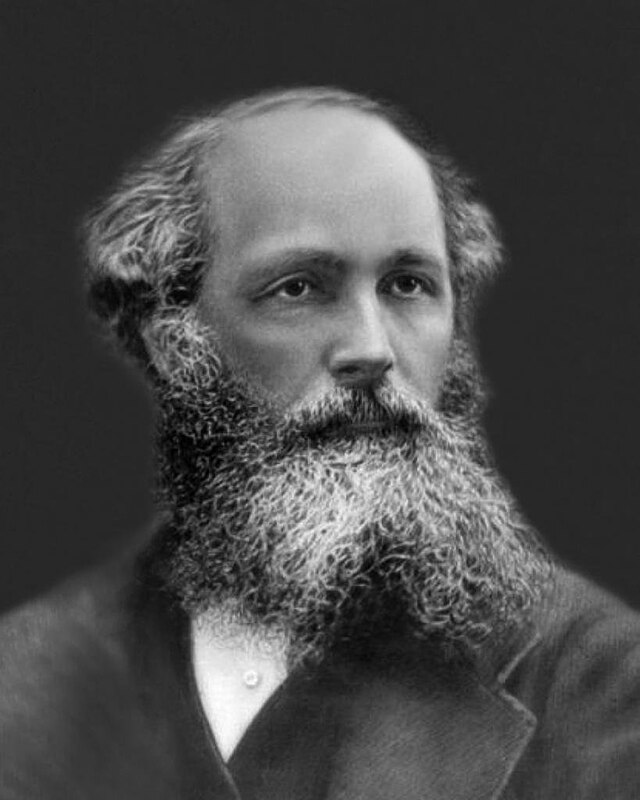
“Maxwell developed the classical theory of electromagnetic induction, unifying electricity, magnetism, and light into a comprehensive theory. He proposed that light is a form of electromagnetic radiation and composed of oscillating electric and magnetic fields traveling at the speed of light.”
Heinrich Hertz experimentally confirmed Maxwell’s theory by generating and detecting electromagnetic waves, specifically radio waves. Maxwell observed inconsistency in Ampere’s circuital laws and symmetry in the laws of electromagnetism. The concept of displacement current removed the inconsistency in Ampere’s circuital law and the laws of electromagnetism also becomes symmetrical.
The above four fundamental laws of physics were stated by Maxwell in the form of four equations, called, “Maxwell’s equations.” The equations predict that time and space dependent electric and magnetic fields propagate as transverse waves, called electromagnetic waves, with a velocity equal to that of light.
The equations are:
1. Gauss’s law in electrostatics:
This law gives the total electric flux in terms of the charge enclosed by a closed surface, where A is the total surface area.

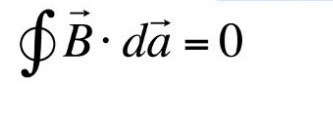
2. Gauss’s law in magnetism:
A direct consequence of Gauss’s law in magnetism is that an isolated magnetic monopole does not exist.
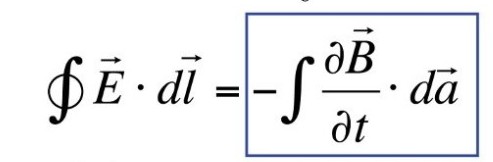
3. Faraday ‘s law of electromagnetic induction:
This law states that the line integral of the electric field along a closed path is equal to the rate of change of magnetic flux through the surface bounded by the closed path.
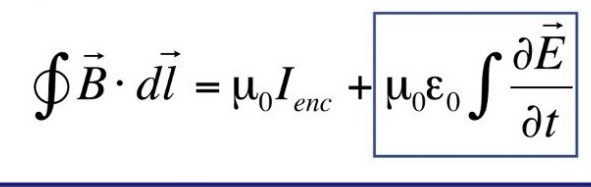
4. Maxwell ampere’s circuital law:
This law states that conduction current and displacement current together have a property of continuity and at an instant, in a circuit, the conduction current is equal to the displacement current.
Based on these equations, Maxwell made the following predictions:
- Electromagnetic waves are produced by accelerating electric charges.
- Electromagnetic waves propagate in space at the speed of light (= 3 × 10⁸ m/s). Electromagnetic waves are transverse in nature.
- Light itself is an electromagnetic wave, it is transverse in nature and it travels through space at a speed of (3 × 10⁸ m/s).
What are Electromagnetic Waves?
Maxwell predicted the existence of electromagnetic waves based on these equations. According to him an accelerating charge produces a sinusoidal time varying magnetic field, which produces a sinusoidal time varying electric field. The two fields thus generated are perpendicular to each other and are sources of each other.
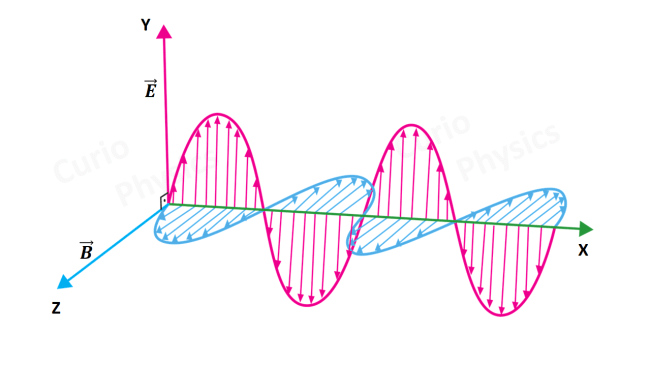
The mutually perpendicular time wearing electric and magnetic fields constitute electromagnetic waves, which propagate in space in a direction perpendicular to the direction of both the field. The electric and magnetic fields are perpendicular to each other and also perpendicular to the direction of wave propagation. Therefore, electromagnetic waves are transverse in nature.
The speed of electromagnetic waves in free space is given by:
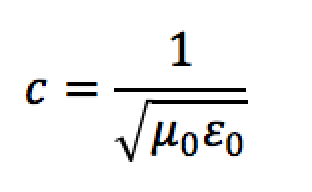
Where, μο (absolute permeability) and ∈o (absolute permittivity) of the free space. The velocity of electromagnetic waves in free space (vacu ght in vacuum, i. e. (3 × 10⁸ m/s).
Examples of Electromagnetic Waves:

- Radio waves: Radio waves have the lowest frequency and longest wavelength and used for broadcasting radio and television signals.
- Microwaves: Used in microwave ovens, radar, and some telecommunications.
- Infrared radiation: Used in thermal imaging, remote controls, and some heating applications.
- Visible light: The portion of the spectrum that humans can see, enabling vision.
- Ultraviolet radiation: Can be harmful in large doses but is also used in sterilization and tanning lamps.
- X-rays: Used in medical imaging to see bones and other internal structures.
- Gamma rays: Gamma rays have the highest frequency and shortest wavelength and used in cancer treatment and sterilization.
Electromagnetic waves propagate as varying electric and magnetic fields, with two fields are perpendicular to each other and also perpendicular to the direction of propagation of the wave. In other words, electromagnetic waves are transverse in nature. Electromagnetic waves are produced by accelerated charges, obey the principle of superposition And do not require any medium to propagate. The electric field vector in an electromagnetic wave is responsible for the optical effect For this reason, the electric vector is called the light vector.
“In upcoming article, we will learn how wave particle duality explained every mystery of light, how it opened the doors of quantum mechanics.” If you have any doubts regarding this topic, please leave your question in the comment section below.
“Stay connected, keep smiling!”
