

Welcome to the series on quantum mechanics. In my last article I explained the origin of quantum mechanics.
In this article I am going to explain about photoelectric effect and how Albert Einstein explained photoelectric effect using the particle nature of light.
What is Photoelectric Effect?
“When a beam of light of appropriate frequency incident on a metal surface, electrons are emitted from the metal surface. This phenomenon is called photoelectric effect. The emitted electrons are called photoelectrons.”
The photoelectric effect was first observed by Heinrich Hertz in 1887. This effect is one of the specific phenomena that provide evidence that photons behave like particles.
The photoelectric effect is not limited to metallic surfaces, but can also occur in gases, liquids and non-metallic solids. Light suitable for producing the photoelectric effect includes the full range of electromagnetic waves, i.e., from the gamma rays and X-rays to the infrared region of wavelengths.
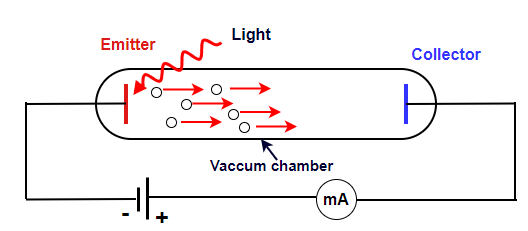
Explanation:
If light of appropriate frequency is fall on the plate, photo electrons will be emitted. When the potential of the plate is positive, a steady saturation current flows in the circuit. When the potential of plate is made negative, the current decreases. At a certain negative potential the photoelectric current becomes zero. This potential is the stopping potential.
If the frequency of light is increased at the stopping potential, then current starts flowing in the circuit. On increasing the stopping potential, this current stops again. Thus, the higher the frequency of the incident light, the greater will be the stopping potential.
What are the laws of photoelectric effect?
- The number of photoelectrons emitted per second varies directly with the intensity of the incident light.
- The maximum energy of photoelectrons is independent of the intensity of the incident light.
- The maximum energy of the photoelectrons increases linearly as the frequency of the incident light increases.
- If the frequency of the incident light is less than a certain value v (threshold frequency) then emission of photoelectrons cannot occur, no matter how strong the light intensity is.
- Emission of photoelectrons will take place immediately without any delay.
Was Maxwell’s electromagnetic theory of light wrong?
In 1865 James Clerk Maxwell proposed his theory that light is an electromagnetic wave composed of oscillating electric and magnetic fields that are perpendicular to each other and propagate through space at the speed of light.
Let me tell you one thing that Maxwell’s theory was not wrong, but when it came to applying this electromagnetic theory of light to the experimental results of the photoelectric effect, the theory could not explain the effect.
What was the difference between the explanation of experimental observations of the photoelectric effect and the explanation of the wave theory?
1) According to the wave theory, when light falls on a metal surface, the energy of the wave is transferred equally to the electrons in the surface before emission. Thus, it is clear that with increase in intensity of light, the energy absorbed by electrons must also increase.
This is against the experimental observation that the maximum energy of emitted electrons is independent of intensity of light.
2) Again, wave theory suggests that light of any frequency should be capable of ejecting electrons from a surface, provided the light is intense enough.
On the other hand, experiments show that light of frequency below a certain threshold value cannot eject photoelectrons, no matter how intense the light is.
3) Moreover, wave theory suggests that if light is incident on a metal surface, electron should take a considerable amount of time to gain enough energy to escape from the surface.
But the experimental results shows no detectable time delay between the incidence of light on the surface and the emission of photoelectrons.
Therefore, the wave theory fails to explain the experimental observations of the photoelectric effect
Einstein’s photon theory:
- Einstein explained the photoelectric effect with the help of the photon theory of light. He assumed that light travels through space as packets of energy called photons or quanta and that the energy of a photon is hv. Where h is Planck’s constant and v is the frequency of light.
- When light falls on a metal surface, a photon of energy hv is completely absorbed by an electron present in the surface. A part of this energy is used to eject the electron against the attraction of the rest of the metal and the remaining part is given to the electrons as kinetic energy.
- Those electrons that exit the surface from some depth lose some of their energy when they collide with atoms. Resulting in the emission of photoelectrons with a range of kinetic energies.
Photoelectric Equation:
Those photoelectrons which are emitted very close to the surface will have the maximum kinetic energy. Which is equal to.
Kinetic energy = 1/2 mv² ___ 1
‘W’ is the energy required to eject an electron against the attraction of the rest of the metal.
W = Work function
We can write-
hv = W + ( 1/2 mv²) , hv = energy of the electron
If the energy of the photon is less than w then the surface will be unable to emit electrons. If v is the threshold frequency then the threshold energy of the photon will be hν₀.
We can write-
W = hν₀ ——- 2
Using 2 and 1 the result will be
hv = hν₀ + ( 1/2 mv²)
In another way we can write-
(1/2 mv²) max = h ( v – ν₀)
This equation is called Einstein’s photoelectric equation.
Explanation of photoelectric laws by Einstein’s photoelectric equation:
- If the intensity of light of a given frequency v is increase the number of photons striking at the surface per second will also increase. However, the energy hv of each photon will remain the same.
- Therefore, the number of electrons emitted per second will increase but their maximum energy ( 1/2 mv²) will remain the same. Therefore, we can say that the equation successfully explains photoelectric laws 1 and 2
- It is also clear from Einstein’s equations that the maximum energy of photoelectrons will increase linearly with an increase in the frequency ‘v’ of the incident light. This explains the third law of photoelectric emission.
- It is clear from the photoelectric equation that if v is less than ν₀, then the kinetic energy of photoelectrons will be negative which is impossible. This means that if the frequency v of the incident light is less than the threshold frequency ν₀ then photoelectrons will not be emitted. This explains the fourth law of photoelectric emission.
- Eventually, as soon as the first photon hits the surface, the electron will instantly absorb this energy and escape from it immediately. Hence, it will happen instantly without any delay. This explains the fifth law of photoelectric emission.
Einstein’s explanation of the photoelectric effect suggests that electromagnetic radiation is made up of discrete packets of energy, called photons. Which demonstrates the particle nature of light. Photons are fundamental and discrete units of energy. Each photon has energy E = hv and momentum p = hv/c.
Additionally, photons are stable, electrically neutral and massless elementary particles and always travel at the speed of light. The mass of a photon is m = hv/c² and do not exist at rest. Photons always travel at the speed of light whether in a vacuum or in a medium.
Applications of Photoelectric effect:
- In photo controlled circuits. For example, alarms, auto switch off street lights, automatic traffic control and control of railway crossings etc.
- Automatic counting of the people entering a hall, to find the capacity of a substance, control of furnace temperature.
- Determination of relative colour of face, detection of smoke and for fast transmission in T.V broadcast etc.
My next article will be on wave-particle duality.
If you have any doubts on this topic, please drop your comments in the comment box below. I will try to answer all your questions.
“Stay connected, keep smiling!”
