

Today in my article I will explain everything about Electric Charge. Like what is electric charge, how it is generated and some properties of Electric Charge etc. I am going to explain it in very simple language so that you do not have any problem in understanding it.
What is electric charge?
The study of electric charge, especially when the electric charge is at rest, falls under the branch of physics called electrostatics. Electrostatics focuses on the behavior of electric charges that are not in motion. It involves the study of the forces, fields, and potentials associated with these static charges.
Electric charge is a fundamental property of matter. It is produced by the rubbing of two substances and experiences a force when placed in an electromagnetic field (electric and magnetic fields). There are two types of electric charges: positive and negative. Like charges (positive-positive or negative-negative) repel each other, while opposite charges (positive-negative) attract.
Who gave the name positive and negative to electric charges?

“Benjamin Franklin one of the Founding Fathers of the United States is credited with naming electric charges as positive and negative.”
In the 18th century, while experimenting with electricity, Franklin identified two types of electrical states and named them as positive and negative. He observed that when certain materials were rubbed together, they attracted or repelled each other, and he used these observations to develop his theory of electric charge.
What is Benjamin Franklin’s electrical theory?
Before Franklin’s work, scientists believed that electricity involved the interaction of two different fluids. Franklin, on the other hand, proposed a single-fluid model of electricity. According to him, electricity was a type of fluid that could flow between objects.
Moreover, when this fluid is transferred from one object to another, the object losing the fluid becomes positively charged, and the object gaining the fluid becomes negatively charged. While the choice of which charge should be called positive and which negative was basically arbitrary. Franklin gave his theory before the discovery of the electron and proton.
He defined the direction of electric current as flow from positive to negative. However, we all know that the direction of electron flow, which constitutes electric current, is from negative to positive. But we still use the convention of flowing current from positive to negative.
How charges are produced?
When two objects are rubbed together, charges are generated due to friction.
- When the glass rod is rubbed with silk, the glass rod loses electrons and the silk gains electrons. This means the glass rod becomes positively charged and the silk becomes negatively charged.
- Similarly, when rubber is rubbed with fur the rubber gains electrons and the fur loses electrons. This means the rubber becomes negatively charged and the fur becomes positively charged.
- Suppose there are two glass rods that have been rubbed with silk and two rubber rods that have been rubbed with fur.
- When we bring two glass rods (rubbed with silk) close to each other they repel each other. Similarly, when we bring the two rubber rods (rubbed with fur) close to each other they repel each other. On the other hand, when we bring the rubber rod (rubbed with fur) close to the glass rod (rubbed with silk) they will attract each other.
In this way, charges are produced by the interaction of two substances.
“When we bring two glass rods (rubbed with silk) and rubber rods (rubbed with fur) near a piece of paper, they also attract that piece of paper.”
How does a charged object attract a neutral object?
This happens due to polarization of charges:
Charges are usually distributed evenly throughout the object. When a positively charged object is brought near a neutral object, it attracts that neutral object towards itself. Since the object is positively charged, it attracts the negatively charged particle inside the neutral object.
As a result, the part near the positively charged object becomes negative and the other part becomes positive. There will be a redistribution of charges within the neutral object, and there will be a slight separation between the positive and negative charges. As a result, positively charged objects will attract neutral objects.
Similarly, when a negatively charged object is brought near a neutral object, it attracts that neutral object. In this case also there will be redistribution of charges within the neutral object. In this case too, there will be a slight separation between the positive and negative charges. As a result, positively charged objects will attract neutral objects.
“The separation of positive and negative charges within a material due to an external electric field is indeed called the polarization of electric charges.”
What is ionization?
Atoms are made up of three types of particles, negatively charged electrons, positively charged protons, and neutral neutrons. The charge of a proton or electron is the ultimate, natural unit of charge. If the atom is undisturbed. That is, no electron is removed or added from it then the entire atom will become electrically neutral. That is, the algebraic sum of the positive charge of protons and the negative charge of electrons is zero.
If one or more electrons are removed, the remaining positively charged structure is called a positive ion. A negative ion is formed when an atom gains one or more electrons. The process of losing gaining electrons is called ionization.
What is additive nature of charges?
The total charge on an object is equal to the algebraic sum of all the electric charges distributed on the different parts of the object. If q1,q2, q3,……. are electric charges present on different parts of an object, and if q is the total electric charge on the object then
q=q1 + q2 + q3 +…..
What is quantization of charge?
The magnitude of charge on the proton and electron is e= 1.6 × 10⁻¹⁹ C. Since, protons and electrons are the only charged particles that make up matter, the charge on an object must be an integer multiple of ±e. The charge on any object must be equal to-
q= ±ne (where n is an integer)
The charge on an object can be increased or decreased in steps of e. “The fact that all charges are always some integral multiples of an elementary charge (e= 1.6 × 10⁻¹⁹ C) is known as quantization of charge.”
What is law of conservation of charge?
You must have read in mechanics, that the total linear momentum of an isolated system always remains constant. Electric charge also obeys the similar law.
“For an isolated system, the net charge always remains constant. In any physical process the charge may get transferred from one part of the system to another, but net charge remains the same. In other words charges can neither be created nor destroyed. This is called the law of conservation of charge.”
With the help of some examples it will become more clear to you how charge is conserved:
1) As I have already told that when a glass rod is rubbed with silk the glass rod becomes positively charged and the silk becomes negatively charged. The amount of positive charge on the glass rod is exactly equals to the negative charge on the silk.
Thus, the glass rod and silk, which had zero net charge before rubbing, still possesses zero net charge after rubbing.
2) In all nuclear changes, the proton number is found to be unchanged. For example, in nuclear fission of Uranium (₉₂U²³⁵) by one neutron (₀n¹), Barium (₅₆Ba¹⁴¹), krypton (₃₆kr⁹²) and three neutrons (₀n¹) are produced along with liberation of energy.
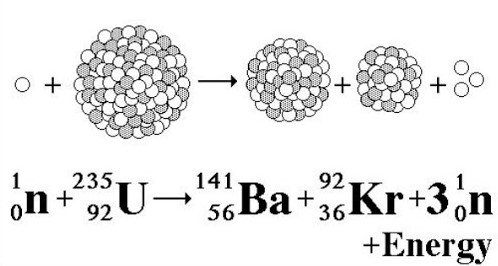
Proton number before fission = Proton number Proton number after fission= 56 + 36 +3(0)= 92
Thus, net charge (proton number) is same before and after the nuclear fission of Uranium.
3) Annihilation of matter ( A positron and an electron combine to produce a Gamma ray Photon) and pair production (a Gamma ray Photon materialises into an electron and positron pair) are two important nuclear phenomena. Charge is conserved in both the process.
Some properties of electric charge:
- Like charges (positive-positive or negative-negative) repel each other, while opposite charges (positive-negative) attract.
- The magnitude of elementary negative or positive charge is same and is equal to 1.6 × 10⁻¹⁹ C.
- The electric charge is additive in nature. it means that that the total charge on an object is the algebraic sum of the charges located at different points on the object.
- The electric charge is quantized. it means charge carried by any charge object is equal to ±ne (“n” is an integer).
- Electric charge obeys the law of conservation of charge.
- Unlike mass, the electric charge on an object is not affected by the motion of the object.
I hope all your doubts are cleared but still if you have any queries then you are welcome. If you want me to write more articles on electrostatics please let me know in the comment box below.
“Stay connected, keep smiling!”
