The post About The Nobel Prize and the 2025 Winners List appeared first on StudyConcepts.
]]>Who established the Nobel Prize?
The Nobel Prize was established by Swedish inventor and businessman Alfred Nobel on 27 November 1895. Alfred Nobel had directed in his last will that his estate should be invested. The interest earned from this should be distributed as rewards among those individuals who have contributed to the physics, chemistry, physiology or medicine, literature, peace, economics and benefited humankind.
In which year was the first Nobel Prize awarded?
The Nobel Prizes were established in 1895, but the first awards were given in 1901. You might be wondering why? Well, here’s the answer. Alfred Nobel died on December 10, 1896. His will was challenged by some relatives and authorities. It took four years to resolve legal and administrative issues before the first prize was awarded in 1901. Therefore, the first Nobel Prize was awarded in 1901. The Nobel Prize in Economic Sciences was added in 1968 and first awarded in 1969.
Who was awarded the first Nobel Prize?
Wilhelm Conrad Röntgen received the first Nobel Prize in Physics for the discovery of X-rays. Jacobus Henricus van ‘t Hoff received the first Nobel Prize in chemistry for his work on chemical dynamics and osmotic pressure. Emil von Behring received the first Nobel Prize in physiology or medicine for his work on serum therapy against diphtheria. Sully Prudhomme received the first Nobel Prize in Literature for his poetry.
Henry Dunant and Frédéric Passy received the first Nobel Prize in peace. Henry was honored for his humanitarian efforts to help wounded soldiers and build international understanding, and Passy for his lifelong dedication to promoting international peace. Ragnar Frisch and Jan Tinbergen received the first Nobel Prize in Economic Sciences for developing and applying dynamic models to the analysis of economic processes.
Nobel Prize is awarded by which organization?
Let us understand one by one-
- The Royal Swedish Academy of Sciences selects the laureates for physics, chemistry and economic sciences.
- The Nobel Assembly at the Karolinska Institutet selects the winner for Physiology or Medicine.
- The Swedish Academy selects the winner for the Nobel Prize in Literature.
- The Norwegian Nobel Committee selects the winner for the Nobel Prize in peace.
Who was awarded the Nobel Prize this year?
1) John Clarke a professor at the University of California, Berkeley, Michel H. Devoret a professor at Yale University and the University of California and John M. Martinis a professor at the university of California, are awarded the Nobel Prize in Physics. For their experiments demonstrating quantum mechanical tunneling and energy quantization in macroscopic electrical circuits.
Explanation:
Quantum physics is the study of microscopic particles such as electrons and quarks at the smallest scales. Quantum particles shows strange and unpredictable behavior that differs from the macroscopic level. The quantum world is very different, many quantum rules do not apply in the macroscopic level because their effects are averaged out by the vast number of particles.
Well, I’m not going to explain quantum physics. I’v already explained it in my previous article. If you’d like to learn more about this field, you can read my previous article.
The tunneling effect and energy quantization are microscopic phenomena, but this year’s Nobel laureates have shown that under specific conditions they are also possible at the macroscopic level too.
What is Quantum Mechanical Tunneling?
It is a phenomenon where a quantum particle, like an electron, can pass through a potential energy barrier that it does not have enough energy to overcome according to classical physics. This is possible because particles behave like waves as well.
What is Energy Quantization?
It is the theory that energy in certain systems, can only exist in discrete, specific amounts called quanta, rather than a continuous range of values. In classical physics, a particle can possess any amount of energy. For example, a ball rolling down a ramp can have an infinite number of possible energies as it travels from the top to the bottom. In quantum mechanics, energy is like a staircase like a particle can only be on a specific step (energy level), and it can’t exist in between the steps.
2) Susumu Kitagawa (From Japan, a professor at Kyoto University), Richard Robson (from Australia, professor at the University of Melbourne) and Omar M. Yaghi (from the United States, professor at the University of California, Berkeley) have been awarded the Nobel Prize. They have been awarded for their work on developing metal-organic frameworks (MOFs).
Explanation:
These scientists have created a material – metal organic framework (MOFs). These are like sponges made of metal ions. The structure consists of metal ions linked by organic molecules, forming a porous crystalline material with large internal cavities. This means that these MOFs have huge internal surface areas that can trap and store other molecules inside their tiny pores.
This work is useful because it allows scientists to design materials for specific purposes, such as: this can be used to extract water from dry air, which is especially useful in desert regions. Storing gas for clean fuels like hydrogen. Capturing carbon dioxide, to help combat climate change. Filtering and purifying water to make clean water more accessible. Moreover, this can be designed to remove toxic pollutants from water and air. They can separate specific substances, such as rare-earth elements from waste or ethylene gas from fruit to slow ripening.
3) Maria Corina Machado was awarded this year’s Nobel Peace Prize. She is a Venezuelan politician and pro-democracy activist.
Explanation:
She helped unite the opposition in Venezuela and advocated “vote instead of bullet”, promoting peaceful civic participation. Moreover, She was in danger, but she remained in Venezuela to continue her work. This was a commendable move.
For her promotion of democratic rights in Venezuela and his struggle for a peaceful transition from authoritarian rule to democracy. The committee praised her as a “courageous and committed champion of peace” who has inspired millions. The committee praised her as a “courageous and committed champion of peace” who has inspired millions.
4) Mary E. Brunkow, Fred Ramsdell, and Shimon Sakaguchi received the 2025 Nobel Prize in Physiology or Medicine. For their discoveries regarding regulatory T cells (Tregs) and the FOXP3 gene, which are crucial for preventing the immune system from attacking the body’s own tissues.
Explanation:
Mary E. Brunkow and Fred Ramsdell are from the United States, while Shimon Sakaguchi is from Japan. Brunkow is associated with the Institute for Systems Biology in Seattle, and Ramsdell with Sonoma Biotherapeutics in San Francisco. Sakaguchi is from Osaka University in Japan.
In 1995, Shimon Sakaguchi identified a new class of T cells, called regulatory T cells (Tregs). T cells (Tregs) are immune cells that prevent the immune system from attacking the body’s own cells.
Mary E. Brunkow and Fred Ramsdell independently identified the Foxp3 gene in 2001. They discovered that mutations in this gene caused the autoimmune disease in mice and its human equivalent, IPEX syndrome. This work was crucial in confirming that the Foxp3 gene is critical for the development and function of regulatory T cells (Tregs), which maintain immune tolerance.
5) Hungarian writer and novelist Laszlo Krasznahorkai received the Nobel Prize in Literature
Explanation:
The main reason they received the award is that they were able to show how art can survive and provide meaning even in the face of apocalyptic terror. His work is known for its long, unbroken sentences. By unbroken means that the sentences are exceptionally long and complex, flowing continuously for pages. His writing creates a rhythm that captivates the readers.
His work so far suggests that even in this upside-down world, beauty and meaning exist if we try to find it. He is the kind of writer who turns chaos into poetry and despair into a spiritual journey.
Movies based on the works of László Krasznahorkai include adaptations of his novels like Satantango (1994) and Werckmeister Harmonies (2000) by director Béla Tarr, and screenplays he co-wrote for films such as Damnation (1988) and The Turin Horse (2011).
6) Joel Mokyr, Philippe Aghion, and Peter Howitt were awarded the Nobel Prize in Economic Sciences for their work on innovation-driven economic growth. Joel Mokyr is from the Netherlands and is an American-Israeli citizen, Philippe Aghion is from France, and Peter Howitt is from Canada.
Explanation:
Joel Mokyr received half of the prize for identifying the conditions necessary for sustainable development through technological progress. His research focuses on how continuous technological innovation is important to economic growth. He argues that sustainable development depends on a continuous cycle of linking scientific knowledge to practical application and on social factors.
Philippe Aghion and Peter Howitt shared the remaining half for developing a mathematical model of “creative destruction”. His model shows how innovation promotes long-term economic growth by creating new technologies and businesses that replace old ones.
If you want to read more informative articles then you can read all my previous articles. If you want me to write any specific article as per your choice then please let me know in the comment box below.
“Stay connected, keep smiling!”
The post About The Nobel Prize and the 2025 Winners List appeared first on StudyConcepts.
]]>The post About Blood Types/Blood Groups and Blood Group Test appeared first on StudyConcepts.
]]>About blood and its composition :
Blood is a bodily fluid that flows throughout the body. It connects organs and tissues by transporting oxygen, nutrients, hormones, and waste products. The study of blood is called hematology. The four main components of blood are plasma, red blood cells, white blood cells, and platelets.
Plasma is the liquid part of blood, which makes up the majority of blood volume. Blood is composed of approximately 55% plasma and 45% red blood cells (RBCs), white blood cells (WBCs), and platelets. All of these blood cells play important roles in transport, protection, and regulation.
Let’s understand about blood types
What are the blood types/blood groups?
Austrian biologist Karl Landsteiner discovered human blood groups A, B, and O in 1901 and AB blood group was discovered by A. Decastello and Sturli B. Karl in 1902. So, there are four main blood types: A, B, AB, and O. Blood types or blood groups are determined by the presence or absence of specific antigens A and B on red blood cells. These antigens and the Rh factor, classify blood into different groups, such as A, B, AB, O (as I mentioned) and Rh-positive or Rh-negative.
Blood group A – has A antigens on the red blood cells with anti-B antibodies in the plasma. blood group B – has B antigens with anti-A antibodies in the plasma. blood group O – has no antigens, but both anti-A and anti-B antibodies in the plasma. blood group AB – has both A and B antigens, but no antibodies.
You might be wondering what is Rh factor and antigen?
Let’s understand:
1) Rh factor- The Rh factor or RhD antigen is a protein present on the surface of red blood cells. Let’s understand what it actually means.If this protein or Rh factor is present in a person’s blood, he or she will be Rh positive. On the other hand, if a person’s blood doesn’t contain this protein, or the Rh factor, he or she will be Rh negative.
Hence, there are eight common blood types: A+, A-, B+, B-, AB+, AB-, O+, and O-. These are derived from two main systems of blood classification: the ABO system and the Rh factor system.
2) Antigens- Antigens are present on the surface of red blood cells (RBCs). These antigens are made of proteins and carbohydrates and helps in determining the blood group/blood type of a person. They are important for blood transfusions and immune responses.
What is ABO system?
The ABO system is a classification used to group human blood into four types: A, B, AB, and O, based on the presence or absence of A and B antigens on the surface of red blood cells (as I have mentioned above).
What is Rh factor system?
The Rh factor system is a classification of blood based on a protein (RhD antigen) on the surface of red blood cells.
How can we determine the blood group?
I am going to tell you about a test by which we can determine our blood group. You can also do this experiment at home.
Materials required for the experiment: Materials like glass slide, blood group test kit, toothpick, lancet, sterile cotton balls are required to do this blood group test. If you are doing this experiment for someone else then it is very important to wear gloves while doing this experiment.
Blood group test kit contains tubes of three different reagents- Anti-A, Anti-B, and Anti-D(Antisera). The blue coloured tube contains Anti-A agent, the yellow coloured tube contains Anti-B reagent and the transparent tube contains Anti-D reagent.
So, let’s start the experiment:
- Take a clean glass slide and mark it with a marker – A, B & D. Clean your finger thoroughly with sterile cotton balls.
- For testing, draw blood by pricking the skin with a lancet. Remove the first drop of blood to avoid contamination and extra muscular fluid.
- Put a drop of blood where we have made marks A, B and D on the glass slide.
- Add one drop of anti-A to the blood marked ‘A’. Add one drop of anti-B to the blood marked ‘B’. Add one drop of anti-D to the blood marked ‘D’. Do not delay it for too long as it will cause blood clots and the results will not be accurate.
- Take three separate tooth picks to mix the blood and reagent. You can use one slide like I did, or you can use separate slides, depending on your preference.
- Rotate the slide a little and observe, you will see agglutination.
What is Agglutination?
Agglutination means the clumping together of red blood cells, which occurs when specific antibodies bind to antigens on the cell surface. Agglutination is a key principle in many diagnostic tests, such as determining a person’s blood type, because it indicates the reaction between an antibody and its corresponding antigen.
What does the result of the experiment show?
The result will tell the person’s blood group. Let us understand how. Agglutination in A and B will indicate the blood groups and agglutination in D will tell whether the blood group is positive or negative.
- If agglutination occurs in A but not in B and D, the blood group will be A-. If agglutination occurs in B and D but not in A, the blood group will be B+. If agglutination occurs in A, B as well as D then the blood group will be AB+.
- If agglutination occurs in A and D but not in B then the blood group will be A+. If agglutination did not occur in A, but in B and D, the blood group would be B+. If agglutination occurs in D but not in A and B then the blood group will be O+.If there is no agglutination in any of these, i.e. A, B and D, then the blood group will be O-. If agglutination occurs in B and not in A and D then the blood group will be B-.
What happens if a patient is given an incompatible blood group?
The patient must receive a compatible blood group. Incompatible blood groups can cause a serious transfusion reaction. If a patient receives an incompatible blood type, their immune system attacks and destroys the transfused red blood cells. This causes a severe reaction, which can lead to shock, kidney failure, and even death.
Note- A person with AB+ blood group is a “universal acceptor”, their blood can receive transfusions from any blood group (A, B, AB, or O), including both Rh positive and Rh negative.
A person with O- blood group is a universal donor, their blood can be transfused to recipients of any blood group (A, B, AB, or O), both Rh positive and Rh negative.
I hope you found my article informative. If you have any doubts in your mind then please leave your questions in the comment box below.
“Stay connected, keep smiling!”
The post About Blood Types/Blood Groups and Blood Group Test appeared first on StudyConcepts.
]]>The post How to Improve My English Speaking Skills appeared first on StudyConcepts.
]]>We all want to present ourselves well to people in some way or the other. Whether it’s good looks, intelligence, or speaking skills. If you follow my methods and apply them to your speaking skills, your speaking style will sound impressive and you will appear confident.
Before I get into this, I would like to tell you something that is very important to understand:
Language is a medium through which we communicate with people. Nowadays, people consider speaking English a status symbol, which is absolutely wrong. Sometimes they even associate it with intelligence. There is a difference between having in-depth knowledge of any language and speaking that language fluently.
Being able to speak any language fluently does not indicate that you have a great knowledge of that language. We speak the language we hear the most, whether it’s Hindi, English, Spanish, German, or any other language. Speaking a language depends on where we live, what language the people around us speak, and not on intelligence.
What are the ways in which we can improve our speaking ability?
1) Try to pronounce each word correctly:
Unless you pronounce the words correctly, you will never become a good speaker. The biggest mistake people make these days while speaking English is that they think that by using difficult words people will like their way of speaking English. However, difficult English words definitely add value to your speaking but it will sound good to people as long as you are getting the pronunciation right.
You can improve your English speaking skills not by using difficult English words, but by pronouncing each word clearly and correctly. I am not saying here that you should not use such difficult words, rather you should definitely use them. All I am saying is that if you want to use such words then make sure that you know its correct pronunciation. By difficult I mean words that are difficult to pronounce.
2) Try to add emotion and make sure to focus on full stops and commas:
What I mean by adding emotion is that when you are speaking English, if you convey emotions like happiness, sadness, love etc. to people through your words, it sounds very attractive. If you are just speaking without any emotion, it will not make your way of speaking sound good. Here by emotion I mean that your words should express your feelings.
Additionally, don’t ignore full stops and commas. If you’re simply speaking without any pauses, it means you’re not paying attention to full stops or commas. This indicates that your full attention is on the answer and not on the way you speak. When talking to someone or answering a question, add emotion to your words and pay special attention to full stops and commas. If you do this, the other person will like talking to you. By doing this, it shows you as a confident and good speaker.
3) Use idioms when speaking:
You can make your English speaking style impressive by using idioms in conversation. Here are two things you should keep in mind:
- You should know the meaning of the idiom you are using well.
- Don’t use too many idioms.
What I mean by the above points is that you should know very well which idiom to use where. So, use it wisely. Apart from this, you should use selective idioms in your conversation. If you don’t pay attention to this, your English won’t sound impressive at all. Rather, it will indicate that you know English, but you don’t know the correct way to speak it. Therefore, use idioms at the right place and use them only as much as necessary.
I’ve told you how to improve your English speaking skills. Now let’s learn some idioms.
List of idioms, their meanings and their use in sentences:
1) Not my cup of yea:
It means something you don’t like or enjoy. You can also understand it this way, something doesn’t suit your taste or interest.
For example- If someone asks you, “Do you like eating pizza, do you like watching horror movies or web series?” If you don’t like any or all of these things, you can say, “That’s not my thing.”
2) The grass is greener on the other side:
It means that people often think that other people’s lives and situations are better than their own But when you actually experience those things, you realize that they also have their own problems. In short, people are never satisfied with their situation, they always think that other people are in a better situation.
For example – Suppose you’re rich, living a wonderful life, but feeling unhappy inside. A friend tells you that you’re so lucky to have everything in life. Since you are unhappy with your life, you can say, “The grass is always greener on the other side.”
3) What’s sauce for the goose is sauce for the gander:
This idiom means that what is acceptable to one person should also be acceptable to another, especially in the same situation. It’s all about equal treatment. If a rule works for one person, it should work for another person too.
For example- Anyone who argues in favor of gender equality, that is, they believe that the same rules, standards, and behaviors should apply to both men and women, may use this idiom. If you’re talking about fairness. In short, you think fair is fair. Rules and behavior should apply equally to everyone, you can use this idiom in this situation also.
4) Let the cat out of the bag:
This idiom means that someone told you a secret and you accidentally revealed his/her secret.
For example- Suppose you planned a surprise birthday party for your mom or you bought a surprise gift for your mom to give her on her birthday but accidentally your sister told this secret to your mom. Here you can use this idiom like this – “My sister let the cat out of the bag”.
5) Too many cooks spoil the soup:
This idiom means that when too many people are doing the same work, the end result is spoiled or ruined due to confusion, conflicting ideas and lack of clear direction.
For example- Let’s say you and your friends are working on the same project at school. Everyone’s different ideas and opinions can create a lot of confusion and ruin the project. Here you can say- “Too many cooks spoil the soup”.
If you want to know more about how to make your English more effective and trendy words, more idioms, then you can leave your comment in the comment box below.
“Stay connected, keep smiling!”
The post How to Improve My English Speaking Skills appeared first on StudyConcepts.
]]>The post About Quantum Physics Part 3: Bohr’s Atomic Model, de Broglie’s Hypothesis and Wave–Particle Duality appeared first on StudyConcepts.
]]>In my today’s article I am going to give simple explanation on Bohr’s theory, de Broglie hypothesis and wave particle duality.
What is Bohr’s atomic model?
In 1913 Bohr gave the idea of atomic structure to explain the stability of the atom and the emission of sharp spectral lines. He modified the Rutherford model and proposed the following assumptions.
The electrons revolve around the nucleus in certain descreate orbits. While revolving in these allowed orbits the electrons do not emit or absorb electromagnetic radiation, even though they are in accelerated motion. Therefore, the atom is stable.
It will be possible for an electron to revolve only in an orbit for which the orbital angular momentum is an integer multiple of h/ 2π. If L (mvr) is the angular momentum then we can write-
mvr= nh/ 2π
n= 1,2,3,….. and h= Planck’s Constant
When an electron jumps from one allowed orbit to another the atom emits radiation.
The radiation is emitted or absorbed in the form of a single photon whose energy hv is equal to the difference in the energies “ΔE” of the electron in the two orbits.
Thus, ΔE = hv, v= frequency
How did Bohr’s theory explain the hydrogen spectrum?
The spectrum of the hydrogen atom is consist of many lines. These are divided into a number of series. Such as Lyman, Balmer, Paschen, Brackett, and Pfund series. These sharp spectral lines are the hydrogen spectrum and cannot be explained by classical theory. Bohr’s explained by applying Planck’s quantum hypothesis to Rutherford’s atomic model.
Bohr’s proposed two theories:
An electron can move only in orbits for which the angular momentum ‘L’ of the electron is an integer multiple of h/2π.
Absorption of radiation by an atom occurs when the electron jumps from one allowed orbit to another. The radiation is emitted or absorbed as a single photon whose energy ‘hv’ is equal to the difference between the energies of the electron in the two orbits.
That is, hv= E – e,
E= energy of the initial orbit and e= energy of the final orbit
When the hydrogen atom gets enough energy from outside, the electron moves from the inner orbit of lower energy to the outer orbit of higher energy. After 10⁻³ seconds the electron jumps back to the inner orbit by emitting radiation of wavelength which will be equal to.
1/ λ = R( 1/m² – 1/n²)
For,
m = 1 and n = 2,3,4…. We obtain Lyman series
m = 2 and n = 3,4,5…. We obtain Balmer series
m = 3 and n = 4,5,6…. We obtain Paschen series
m = 4 and n = 5,6,7…. We obtain Brackett series
m = 5 and n = 6,7,8….. We obtain Pfund series
Energy level diagram of hydrogen:

What were the shortcomings of Bohr’s theory?
- Bohr’s theory succeeded in explaining hydrogen spectrum and also gave information about atomic structure but it has some limitations which I am going to discuss one by one.
- An individual line in the hydrogen spectrum consists of many blurred lines, which is called the fine structure of hydrogen. Bohr’s theory was unable to explain this. When individual lines of the hydrogen spectrum were examined, it was found that they had lines very close to each other. This is called the fine structure of hydrogen. Bohr’s theory was unable to explain this.
- Bohr’s theory was unable to explain the variation in the intensity of the spectral lines of an element.
- This theory only applies to atoms with only one electron, such as the hydrogen atom, isotopes of hydrogen (deuterium), and ions with only one electron, such as singly ionized helium (He⁺) or doubly ionized lithium (Li²⁺). It does not explain the spectra of complex atoms.
- This theory could not give a satisfactory explanation about the distribution of electrons in atoms.
The De Broglie hypothesis explains Bohr’s theory’s limitations by introducing the concept of wave-particle duality for matter,
What is de Broglie’s hypothesis of matter wave?
The phenomena of interference, diffraction and polarization of light can be explained on the basis of the wave nature of light. However, there are some phenomena which could not be explained on this wave theory of radiation. For example, photoelectric effect, Compton effect etc. These effects can only be explained on the basis of the particle nature of radiation. Thus, the dual nature of wave and particle became associated with light. In 1924 Louis de Broglie put forward the suggestion that matter exhibits wave like properties.
The De- Broglie’s hypothesis explains Bohr’s theory’s limitations by introducing the concept of wave-particle duality for matter. De-Broglie’s hypothesis for matter waves, also known as wave-particle duality, states that all moving particles, such as electrons, protons and all matter, have both particle-like and wave-like properties. Just as light can act as both a wave and a particle (photon).
What is wave–particle duality?
Wave particle duality is that all matter exhibits both wave like and particle like properties. in other words we can say they show wave like and particle like behavior. Wave-particle duality means that all matter exhibits both wave-like and particle-like properties. In other words, they show both wave-like and particle-like behavior. This applies to all objects, even microscopic ones.
Bohr’s model of the atom shows two features:
Electron is considered as a wave and light is considered as a particle (photon).
But this concept contradicts the earlier phenomenon that an electron behaves as a particle and light as a wave, which is provided by the relation,
(λ = h/mass × speed), that connects the mass and speed of an electron to the wavelength of the corresponding wave and E= h × frequency, which links the frequency of a light wave to the energy of the corresponding photon.
Now the question arises:
- what is an electron? Is it a particle or a wave?
- What is light? Is it a wave or a photon? The answer is wave-particle duality.
The answer is wave-particle duality, which states that all objects sometimes exhibit wave-like behavior and sometimes particle-like behavior depending on the experiment and interaction.
What is the wavelength of a matter wave? ( de Broglie wavelength)
The wavelength of a matter wave, or de Broglie wavelength, is equals to to λ = h/p.
λ is the wavelength, h is Planck’s constant (a fundamental constant of nature), and p is the momentum of the particle. Momentum (p) is equal to the product of the particle’s mass (m) and velocity (v). Therefore, we can write it as λ = h/mv.
This equation shows that the wavelength of a matter wave is inversely proportional to the particle’s momentum. This means that heavier particles or faster-moving particles will have shorter de Broglie wavelengths. Higher velocity or larger mass will result in larger momentum and, consequently, shorter wavelength.
If you have any doubts about any topic related to quantum mechanics, please let me know in the comments section. I will definitely write an article on it.
“Stay connected, keep smiling!”
The post About Quantum Physics Part 3: Bohr’s Atomic Model, de Broglie’s Hypothesis and Wave–Particle Duality appeared first on StudyConcepts.
]]>The post About Mixed Gland: Pancreas, Ovary, Testis and Diabetes appeared first on StudyConcepts.
]]>In my previous article I have explained about exocrine glands and endocrine glands. If you want to read my previous article: About Exocrine Glands, Endocrine Glands, Mixed Glands and Liver
What is a Mixed Gland?
A mixed gland, also known as a heterocrine/exo-endocrine gland, is a gland that has both endocrine and exocrine functions. Endocrine glands secrete substances directly into the bloodstream and exocrine glands secrete substances through ducts onto the epithelial surface.
Mixed glands on the other hand secrete substances (hormones, enzymes, juices, or other products) into ducts to reach a surface and directly into the bloodstream.
Examples of mixed glands are: pancreas, testes, ovaries, and submandibular salivary glands.
Let us understand each type of mixed gland one by one.
1) Pancreas:
The pancreas is the second largest gland in humans. The pancreatic cells are called islets of Langerhans because they form clusters or “islands” of endocrine cells scattered within the exocrine tissue of the pancreas. The islets of Langerhans in the pancreas contain alpha, beta, delta, gamma, and epsilon cells, which produce various hormones
German pathologist Paul Langerhans described these distinctive clusters of endocrine cells within the pancreas in 1869. The name “Langerhans” was given to these islets to acknowledge Paul Langerhans’s discovery and description of them.
Location: It is located in the abdomen behind the stomach
What are the functions of the pancreas?
- The initial digestion of carbohydrates and proteins occurs in the mouth and stomach. Some carbohydrates and proteins are not broken down in the mouth and stomach.
- The pancreas plays a vital role in breaking down these remaining carbohydrates and proteins into smaller molecules that the body can absorb by releasing digestive enzymes into the small intestine. Apart from this, digestion of fat also takes place in the pancreas.
- The pancreas also secretes sodium bicarbonate which is needed to neutralize the highly acidic contents of the stomach, and create a neutral environment in the small intestine for pancreatic enzymes to work effectively.
- The pancreas passes its digestive juices to the small intestine, specifically the duodenum, where most of the chemical digestion and absorption of nutrients occurs.
- Pancreatic enzymes are released in an inactive form, which prevents them from digesting the pancreas itself. They become active only when they reach the small intestine.
- The enzymes produced by the pancreas, along with bile from the liver, are vital for the complete digestion of food into absorbable components.
What are the harmones produced by the pancreas?
As I have already mentioned, the islets of Langerhans in the pancreas contain alpha, beta, delta, gamma and epsilon cells, which produce various hormones. Let us understand about these hormones.
- Alpha cells: Produce glucagon, a hormone that increases blood glucose levels.
- Beta cells: They produce insulin, which lowers blood glucose levels.
- Delta cells: Secrete somatostatin, which regulates the release of other pancreatic hormones.
- Gamma cells: Produce pancreatic polypeptide, a hormone that helps regulate endocrine and exocrine secretions of the pancreas.
- Epsilon cells: Produce the hormone ghrelin, which stimulates hunger.
What happens when insulin levels in the body decrease?
Insulin is responsible for moving glucose from the blood into the cells for energy. Without enough insulin, this glucose builds up in the bloodstream, causing levels to rise dangerously high. When insulin levels are low, glucose cannot enter the body’s cells for energy, leading to high blood sugar.
“Inadequate or ineffective insulin causes hyperglycemia. This is a medical condition in which blood sugar (glucose) levels become higher than normal.”
This can cause symptoms such as fatigue and excessive thirst. Moreover , high blood sugar can cause serious health complications such as heart disease, kidney disease, and nerve damage. Lack of insulin can lead to diabetic ketoacidosis (DKA), a life-threatening condition.
What is Diabetes?
Diabetes is a long-term condition in which blood sugar (glucose) levels are too high because the body either does not make enough insulin or cannot use the insulin it makes properly.
Types of Diabetes:
The most common types of diabetes are- type 1, type 2 and gestational diabetes
- Type 1 diabetes: The body’s immune system attacks and destroys the insulin-producing cells in the pancreas, resulting in little or no insulin production.
- Type 2 diabetes: In this the body either becomes resistant to insulin or cannot make enough insulin to maintain normal blood sugar levels.
Gestational Diabetes: It is a type of diabetes that develops during pregnancy. During pregnancy, hormonal changes cause the body’s cells to become less responsive to insulin, a condition known as insulin resistance. If the pancreas cannot produce enough extra insulin to compensate, blood sugar levels become too high, leading to diabetes
If high blood sugar caused by diabetes isn’t controlled, it can cause serious health problems that over time can affect the heart, blood vessels, nerves, kidneys, and eyes.
Treatments: Lifestyle changes, such as a healthy diet and regular exercise, are very important. Additionally, medications, including oral medications and insulin injections, may also be necessary to control blood sugar levels.
Note- Type 1 diabetes requires daily insulin injections to survive, while lifestyle changes can help prevent or delay type 2 diabetes and gestational diabetes.
What are the harmones produced by the pancreas?
The pancreas produces three main types of digestive enzymes: amylase, protease, and lipase. As I already mentioned, these enzymes, combined with sodium bicarbonate, help neutralize stomach acid and break down food, making the digestion of sugars, proteins, and fats easier.
- Amylase: It helps break down complex carbohydrates (sugars) into smaller molecules.
- Proteases: These are a large and important group of enzymes that help break down proteins. For examples:
- Trypsin: Helps in protein digestion.
- Chymotrypsin: Another protease that digests proteins.
- Lipase: helps break down fat into its components.
2) Ovary
The ovary is another example of a mixed gland. The ovaries are another example of a mixed gland. Like the pancreas, the ovaries also perform both endocrine functions (produce hormones such as estrogen and progesterone) and exocrine functions (produce eggs or ova, which are female gametes).
Hormones produced by Ovaries are:
Endocrine function:
Estrogen: It helps regulate the menstrual cycle, develop female sexual characteristics. For example: breasts and pubic hair. Apart from this, it also helps in preparing the reproductive organs for pregnancy. It also plays an important role in maintaining bone health, supporting the cardiovascular system, and affecting the brain, skin, hair, and mood.
Progesterone: It helps prepare the uterus for pregnancy by thickening and maintaining the uterine lining. If pregnancy does occur, it supports the developing fetus and promoting the growth of the placenta.
Exocrine function:
The ovaries help produce and release female reproductive cells, known as ova (egg cells).
It helps to carry the female’s genetic material, which contributes to the traits of the new organism. Additionally, it helps provide the nutrients and cytoplasm necessary for the initial stages of embryo.
3) Testis:
The testis is also an example of a mixed gland. As I mentioned above, a mixed gland performs both endocrine and exocrine functions.
Endocrine Function:
The testes produce steroid hormones, mainly testosterone.
Testes secrete these hormones directly into the bloodstream. Testosterone plays an important role in the development and maintenance of male sexual characteristics and function.
Exocrine Function:
The testes help in producing sperm. The process by which sperms (male gametes) are produced from immature male germ cells (spermatogonia) in the testis is known as spermatogenesis.
The sperm are released into a duct system (vas deferens or ductus deferens) and carries them to the reproductive tract. These are the male reproductive cells, which are necessary for fertilization and reproduction.
If you have any doubt regarding today’s article or you want me to write more articles related to biology then please let me know in the comment box below.
“Stay connected, keep smiling!”
The post About Mixed Gland: Pancreas, Ovary, Testis and Diabetes appeared first on StudyConcepts.
]]>The post About Quantum Physics Part 2: Photoelectric Effect, Failure Of Wave Theory and Einstein’s Photon Theory appeared first on StudyConcepts.
]]>In this article I am going to explain about photoelectric effect and how Albert Einstein explained photoelectric effect using the particle nature of light.
What is Photoelectric Effect?
“When a beam of light of appropriate frequency incident on a metal surface, electrons are emitted from the metal surface. This phenomenon is called photoelectric effect. The emitted electrons are called photoelectrons.”
The photoelectric effect was first observed by Heinrich Hertz in 1887. This effect is one of the specific phenomena that provide evidence that photons behave like particles.
The photoelectric effect is not limited to metallic surfaces, but can also occur in gases, liquids and non-metallic solids. Light suitable for producing the photoelectric effect includes the full range of electromagnetic waves, i.e., from the gamma rays and X-rays to the infrared region of wavelengths.
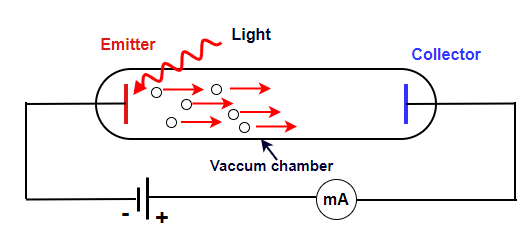
Explanation:
If light of appropriate frequency is fall on the plate, photo electrons will be emitted. When the potential of the plate is positive, a steady saturation current flows in the circuit. When the potential of plate is made negative, the current decreases. At a certain negative potential the photoelectric current becomes zero. This potential is the stopping potential.
If the frequency of light is increased at the stopping potential, then current starts flowing in the circuit. On increasing the stopping potential, this current stops again. Thus, the higher the frequency of the incident light, the greater will be the stopping potential.
What are the laws of photoelectric effect?
- The number of photoelectrons emitted per second varies directly with the intensity of the incident light.
- The maximum energy of photoelectrons is independent of the intensity of the incident light.
- The maximum energy of the photoelectrons increases linearly as the frequency of the incident light increases.
- If the frequency of the incident light is less than a certain value v (threshold frequency) then emission of photoelectrons cannot occur, no matter how strong the light intensity is.
- Emission of photoelectrons will take place immediately without any delay.
Was Maxwell’s electromagnetic theory of light wrong?
In 1865 James Clerk Maxwell proposed his theory that light is an electromagnetic wave composed of oscillating electric and magnetic fields that are perpendicular to each other and propagate through space at the speed of light.
Let me tell you one thing that Maxwell’s theory was not wrong, but when it came to applying this electromagnetic theory of light to the experimental results of the photoelectric effect, the theory could not explain the effect.
What was the difference between the explanation of experimental observations of the photoelectric effect and the explanation of the wave theory?
1) According to the wave theory, when light falls on a metal surface, the energy of the wave is transferred equally to the electrons in the surface before emission. Thus, it is clear that with increase in intensity of light, the energy absorbed by electrons must also increase.
This is against the experimental observation that the maximum energy of emitted electrons is independent of intensity of light.
2) Again, wave theory suggests that light of any frequency should be capable of ejecting electrons from a surface, provided the light is intense enough.
On the other hand, experiments show that light of frequency below a certain threshold value cannot eject photoelectrons, no matter how intense the light is.
3) Moreover, wave theory suggests that if light is incident on a metal surface, electron should take a considerable amount of time to gain enough energy to escape from the surface.
But the experimental results shows no detectable time delay between the incidence of light on the surface and the emission of photoelectrons.
Therefore, the wave theory fails to explain the experimental observations of the photoelectric effect
Einstein’s photon theory:
- Einstein explained the photoelectric effect with the help of the photon theory of light. He assumed that light travels through space as packets of energy called photons or quanta and that the energy of a photon is hv. Where h is Planck’s constant and v is the frequency of light.
- When light falls on a metal surface, a photon of energy hv is completely absorbed by an electron present in the surface. A part of this energy is used to eject the electron against the attraction of the rest of the metal and the remaining part is given to the electrons as kinetic energy.
- Those electrons that exit the surface from some depth lose some of their energy when they collide with atoms. Resulting in the emission of photoelectrons with a range of kinetic energies.
Photoelectric Equation:
Those photoelectrons which are emitted very close to the surface will have the maximum kinetic energy. Which is equal to.
Kinetic energy = 1/2 mv² ___ 1
‘W’ is the energy required to eject an electron against the attraction of the rest of the metal.
W = Work function
We can write-
hv = W + ( 1/2 mv²) , hv = energy of the electron
If the energy of the photon is less than w then the surface will be unable to emit electrons. If v is the threshold frequency then the threshold energy of the photon will be hν₀.
We can write-
W = hν₀ ——- 2
Using 2 and 1 the result will be
hv = hν₀ + ( 1/2 mv²)
In another way we can write-
(1/2 mv²) max = h ( v – ν₀)
This equation is called Einstein’s photoelectric equation.
Explanation of photoelectric laws by Einstein’s photoelectric equation:
- If the intensity of light of a given frequency v is increase the number of photons striking at the surface per second will also increase. However, the energy hv of each photon will remain the same.
- Therefore, the number of electrons emitted per second will increase but their maximum energy ( 1/2 mv²) will remain the same. Therefore, we can say that the equation successfully explains photoelectric laws 1 and 2
- It is also clear from Einstein’s equations that the maximum energy of photoelectrons will increase linearly with an increase in the frequency ‘v’ of the incident light. This explains the third law of photoelectric emission.
- It is clear from the photoelectric equation that if v is less than ν₀, then the kinetic energy of photoelectrons will be negative which is impossible. This means that if the frequency v of the incident light is less than the threshold frequency ν₀ then photoelectrons will not be emitted. This explains the fourth law of photoelectric emission.
- Eventually, as soon as the first photon hits the surface, the electron will instantly absorb this energy and escape from it immediately. Hence, it will happen instantly without any delay. This explains the fifth law of photoelectric emission.
Einstein’s explanation of the photoelectric effect suggests that electromagnetic radiation is made up of discrete packets of energy, called photons. Which demonstrates the particle nature of light. Photons are fundamental and discrete units of energy. Each photon has energy E = hv and momentum p = hv/c.
Additionally, photons are stable, electrically neutral and massless elementary particles and always travel at the speed of light. The mass of a photon is m = hv/c² and do not exist at rest. Photons always travel at the speed of light whether in a vacuum or in a medium.
Applications of Photoelectric effect:
- In photo controlled circuits. For example, alarms, auto switch off street lights, automatic traffic control and control of railway crossings etc.
- Automatic counting of the people entering a hall, to find the capacity of a substance, control of furnace temperature.
- Determination of relative colour of face, detection of smoke and for fast transmission in T.V broadcast etc.
My next article will be on wave-particle duality.
If you have any doubts on this topic, please drop your comments in the comment box below. I will try to answer all your questions.
“Stay connected, keep smiling!”
The post About Quantum Physics Part 2: Photoelectric Effect, Failure Of Wave Theory and Einstein’s Photon Theory appeared first on StudyConcepts.
]]>The post About Quantum Physics Part 1: Black Body Radiation, Ultraviolet Catastrophe, Planck’s Radiation Law appeared first on StudyConcepts.
]]>“Quantum Physics was first introduced when Max Planck derived the correct mathematical law for the distribution of energy in black body radiation.”
Before I begin with this it is important to know what is classical physics and what is the need of quantum physics.
What is Classical Physics?
Classical physics also known as Newtonian mechanics is the system, in which Newton’s laws of motion are used and time and distance are considered absolute and invariant. This system has been used successfully for nearly three centuries to deal with a wide variety of problems in physics.
Classical physics developed over several centuries based on observations of moving objects. It correctly explains the motion of celestial bodies, macroscopic and microscopic terrestrial bodies moving with non- relativistic speed.
By the end of the 19th century, it was a common view among physicists that all types of problems could be solved with the help of classical physics. Moreover, there was no limitations on the accuracy of the results.
You may be wondering what is the meaning of “absolute time” and “non-relativistic speed”?
Absolute time: Time passes uniformly for everyone, everywhere, independently of the motion of observers or external factors. According to Newton’s view, time is a distinct dimension, separate from space and absolute, that is same for all observers.
Non-relativistic speed: Speeds much less than the speed of light. Where Newtonian mechanics accurately describes the motion of a moving body. (i.e. v<<c, c= speed of light)
What are the drawbacks of classical physics?
In cases of our everyday experience, which involve relatively large particles and relatively slow-moving objects, the results of classical physics match experiments quite well, but classical physics had certain drawbacks.
Classical physics cannot be used at the atomic level. This means when it comes to describing the motion of electrons in atoms, vibrations of atoms, etc.
It was unable to explain the stability of atoms and the absorbed spectrum of black body radiation.
It could not explain the origin of discrete spectra of atoms and observed variation of specific heat of metals and gases.
Moreover, classical physics was unable to explain phenomenon like photoelectric effect, compton effect and Raman effect etc.
“The inadequacy of classical physics led to the development of quantum physics.”
What is Quantum Physics?
Quantum Physics explains the behavior of matter and energy at the atomic and subatomic levels. Where classical physics (like Newtonian mechanics) fails.
According to quantum physics the energy changes are not continuous but discrete. the absorption and emission of energy in atoms is in bundles of energy hv.
V= Frequency, h= Planck’s constant
Quantum Physics is able to explain stability of atoms, spectrum of black body radiation. Moreover, it is also able to explain phenomena like photoelectric effect, Compton effect and theory of alpha decay.
Let’s understand quantum physics in more detail:
What is thermal radiation?
The radiation emitted by the source depending upon its temperature is called thermal radiation. light is produced as a result of their temperature. Hence they are called thermal sources. A thermal source produces a continuous spectrum because thermal radiation is electromagnetic in nature and its energy is distributed over all wavelengths.
At low temperatures the radiation is mainly lies in the infra red region. As body temperature increases, the maximum intensity component shifts to a higher frequency. As the current increases through the filament. It appears initially red, orange and then yellow and finally it emits white light.
What is blackbody?
A perfect black body is a body that absorbs all the radiation that falls on it, regardless of the frequency of the radiation. A black body is an ideal body that neither reflects nor transmits any incident radiation. Therefore, it appears black whatever is the colour of the incident radiation.
If a black body is placed in an isothermal envelope(sphere) , it will emit the entire radiation of the envelope(sphere). Thus, the radiation emitted from an isothermal sphere is similar to that emitted from a black body at the same temperature and is called black body radiation.
Can we create a black body?
Yes, we can also make a black body by making a small hole in a sphere. The hole will act as a perfect absorber. The light entering the cavity reflects multiple times on the walls and gets trapped inside the cavity. As a result, the hole will appear completely dark.
Conversely, when the cavity is heated, the radiation produced in the cavity passes out through the hole, which will include all the wavelengths. Therefore, the whole will act as an perfect emitter.
What are the laws of black body radiation?
This includes the Stefan-Boltzmann law and Wien’s law:
Stefan-Boltzmann’s law: It states that the total radiation emitted from a black body at temperature T is proportional to the fourth power of the absolute temperature of the body.
Wien’s law: It states that the peak wavelength at which the maximum emission occurs for any given temperature is inversely proportional to the absolute temperature of the body.
What were the experimental results?
The experimental results showed that at a given temperature the radiation energy density initially increases with frequency, then peaks at a particular frequency and then finally decreases to zero at a very high frequency.
Various efforts were made to calculate theoretically the frequency distribution of thermal radiation. Rayleigh and jeans also tried and gave Rayleigh jeans law to explain this but there was one drawback.
Raleigh-Jeans Law?
Rayleigh and Jeans assumed that every standing wave must have energy ‘KT’ (according to Boltzmann’s principle of equipartition of energy, each simple harmonic oscillator has an average thermal energy of ‘KT’ at thermal equilibrium) and derived an expression for the energy density of the radiation distribution within the cavity.
The expression is –
E(v) = 8 π v² kT/ c³
k = Boltzmann constant and T = Temperature
This result is known as Raleigh-Jeans Law
What is ultraviolet Catastrophe?
The energy density calculated from the upper formula matched the experimental result well at long wavelengths of the spectrum, but it was predicting an infinite amount of energy for very short wavelengths.
This meant that the radiation emitted by a hot body must consist of a large portion of UV rays. This violates the law of conservation of energy. This is known as the “Ultraviolet Catastrophe.”
The result was showing inconsistencies between observations and the predictions of classical physics.
This showed the need for a new approach to physics. Max Planck later developed his theory to solve this problem, incorporating the concept of quantized energy into his formula and providing the correct blackbody radiation curve by introducing his law know as ” The Planck’s Radiation Law”.
The Planck’s Radiation Law:

According to the classical theory of radiation, energy changes in radiators occur continuously. Classical mechanics could not explain the experimental observation i.e. the distribution of energy in the spectrum of a black body.
After a long struggle, in 1900 Planck succeeded in obtaining the correct mathematical law for the distribution of energy in black body radiation. He recognized that the cause of the ultraviolet catastrophe was Rayleigh’s assumed that standing waves consist of an infinite number of harmonic modes of vibration.
Each of these modes was assumed to have an energy KT, leading to the absurd result that the total energy in the cavity would be infinite. Therefore Max Planck put forward a postulate that an oscillating atom can absorb or emit energy only in quantities that are integer multiples of “hv”. The invisible discrete unit of energy hv is called an energy quantum.
Energy of an oscillator will be
E = nhv
n = Quantum number of the oscillator ( n = 1,2,3,….)
h = Planck ‘s constant
Eventually, Max Planck gave the final result by using Maxwell Boltzmann distribution law and including the discreteness in the emission of energy.

This is “Planck’s radiation law” . This formula given by Max Planck correctly describes blackbody radiation at all wavelengths.
The failure I have described exposed the limitations of classical physics and set the stage for Max Planck’s quantum theory.
The inability of classical physics to explain the continuous spectrum emitted by a black body gave birth to quantum physics. Planck’s hypothesis of a discreet quanta of energy was the foundation of quantum physics.
In my next article I will explain about photoelectric effect.
If you have any doubt regarding this article, please drop your question in the comment box below, I will definitely try to answer it.
“Stay connected, keep smiling!”
The post About Quantum Physics Part 1: Black Body Radiation, Ultraviolet Catastrophe, Planck’s Radiation Law appeared first on StudyConcepts.
]]>The post About Symptoms, Causes and Treatments of PCOD appeared first on StudyConcepts.
]]>Before knowing about PCOD and PCOS, let us know about ovulation and menstrual cycle.
What is Ovulation?
The hypothalamus is the part of the brain that helps maintain body temperature, regulate feelings of hunger and fullness, and control the sensation of thirst. Additionally, it manages sleep-wake cycles controls emotions and mood and controls sexual desire.
The hypothalamus releases gonadotropin-releasing hormone (GnRH). This hormone is then released into the bloodstream into the hypophyseal portal system (network of blood vessels), which carries it to the anterior pituitary gland.
Gonadotropin-releasing hormone (GnRH) stimulates the anterior pituitary gland to release luteinizing hormone (LH). Luteinizing hormone (LH) and follicle-stimulating hormone (FSH) collectively known as gonadotropins.
Follicle-stimulating hormone (FSH) helps the follicles in the ovaries, which contain the eggs, to grow and mature. Luteinizing hormone (LH) helps to release a mature egg from the ovary by weekends the ovarian wall, which is called ovulation. This process of releasing the egg from the ovary is called ovulation.
Menstrual cycle:
The egg is then captured by the fimbriae, finger-like projections at the end of the fallopian tube, and begins its journey toward the uterus.
Ovary produces two hormones such as. These hormones regulate the cycle. When ovary releases an egg into the fallopian tube, which is called ovulation. The lining of the uterus (endometrium) thickens to create a favorable environment for a fertilized egg to grow.
If the egg isn’t fertilized, the lining of the uterus breaks down. The uterine lining, along with the unfertilized egg, blood, and mucus, is shed and exits the body through the vagina as menstrual fluid. This shedding is a normal part of the menstrual cycle, which oсcurs monthly.
What is Polycystic ovarian disease (PCOD)?
Polycystic ovarian disease (PCOD) is a medical condition in which a large number of underdeveloped eggs are produced in a woman’s ovaries during her reproductive age. Polycystic ovarian disease (PCOD) is a medical hormonal imbalance condition in which a large number of underdeveloped eggs are produced in a woman’s ovaries during her reproductive age. The increase in the number of follicles increases the size of the ovary.
In PCOD, the ovulation process gets disrupted, which leads to menstrual problems. This leads to irregular or missed menstrual cycles.
Are Polycystic ovarian disease (PCOD) and Polycystic Ovary Syndrome (PCOS) the same?
Both conditions can cause irregular periods. The early stage of the medical condition in which a large number of immature eggs are produced due to hormonal imbalance is known as PCOS. On the other hand, advanced stage of the medical condition in which a large number of immature eggs are produced due to hormonal imbalance is known as PCOD.
Is PCOD/PCOS the same as ovarian cyst?
In a normal menstrual cycle, a mature egg is released from the ovary every month. While in conditions like PCOD/PCOS, the ovulation process gets disrupted, and the eggs are unable to mature enough to travel from the ovary to the fallopian tubes.
Immature follicles containing undeveloped eggs appear as “cyst-like structures” on ultrasound. However, through the name can be misleading as they are not true “cysts”. Rather these are small, unruptured follicles. These follicles, which are essentially small sacs of fluid that fail to develop and release an egg.
What are the Symptoms of PCOD?
- Women with PCOD/PCOS may experience irregular menstrual periods, and there may be longer gaps between them.
- Painful period due to factors like hormonal Imbalances. It is common to experience skipped or occur very infrequently menstrual periods throughout the year. even absent for months.
- In some cases, periods may become unusually heavy or last for a long time. It is common to have irregular menstrual cycles. This means periods may fluctuate throughout the year or even be absent for months.
- Women may experience thinning hair on their scalp or male pattern baldness. Also, many women experience weight gain, especially around the abdomen and thighs.
- Areas like the neck, armpits, and groin may develop thicker, darker, velvety skin.
- It can also make it difficult for women to conceive because the hormonal imbalance disrupts normal ovulation.
- Unwanted hair growth on the face, chest, and back. Acne and Oily Skin
Less common symptoms are:
Mood swings, depression and headaches. Negative social relationships. Low self-confidence. Negative self-image. Disruption of eating and sleep patterns.
What are the causes of PCOD?
When the body’s cells become resistant to insulin, the pancreas produces more of it to keep blood sugar levels balanced.
This increased level of insulin disrupt the balance of hormones. Moreover, signal the ovaries to produce higher levels of androgens, also known as male hormones. Which then cause many of the reproductive and metabolic symptoms associated with PCOD.
An unhealthy diet and lack of exercise are significant contributing factors to PCOD.
The risk of developing PCOD may increase if a close family member such as a mother or sister is suffering from the it.
Obesity worsen insulin resistance and increase PCOD symptoms
What are the treatments for PCOD?
- Doctors will do a blood test to measure androgen (male hormones) levels in women with PCOD. In addition, other hormones such as luteinizing hormone (LH), follicle-stimulating hormone (FSH) and estrogen will be tested to identify imbalances.
- The doctor will address insulin resistance through treatments such as medication or lifestyle changes (including a healthy diet and regular exercise and maintaining a healthy body weight) is an important part of managing PCOD symptoms.
- A pelvic ultrasound will be done to look at the ovaries. This may reveal if the ovaries are enlarged or contain multiple small, fluid-filled sacs.
- The doctor will discuss your menstrual cycle and check for irregularities, missed periods, or unusually long or heavy menstrual cycles. The doctor will also review the family history of PCOD or diabetes.
- Doctor will also assess your Body Mass Index (BMI) and may check blood pressure and look for signs like dark skin patches (acanthosis nigricans) or skin tags. A physical examination checks for signs of high androgen levels, such as acne or hirsutism.
Note –The PCOD diet suggests avoiding these foods: Refined carbohydrates, found in white bread and mass-produced pastries. Fried foods, especially fast food.
If the above PCOD symptoms match with you then I would suggest you to go to the doctor without waiting and get it treated as soon as possible.
I hope all your doubts are cleared, but still if you have any questions in your mind then write your question in the comment box below. I will try to answer all your questions.
“Stay connected, keep smiling!”
The post About Symptoms, Causes and Treatments of PCOD appeared first on StudyConcepts.
]]>The post Origin of Thermodynamics, Isothermal Process and Adiabatic Process appeared first on StudyConcepts.
]]>What is heat?
Heat is a type of energy that is transferred from one body to another due to difference in temperature. Heat always flows from a hotter object to a colder object until they reach a state of thermal equilibrium. The measure of the average heat in a substance is called temperature.
What is thermodynamics?
Thermodynamics is a branch of physics that studies about heat and the effects of changes in temperature, pressure, and volume on physical systems at the macroscopic scale.
“French mechanical engineer and physicist Nicolas Leonard Sadi Carnot is known as the the father of thermodynamics.” For publishing Reflections on the Motive Power of Fire in 1824.
History of thermodynamics:
Aristotle (ancient Greek philosopher) believed that a vacuum, or a space without matter was is impossible because “nature abhors a vacuum”. Aristotle believed that empty space could not exist, because nature continually fills any empty space with denser surrounding material, preventing a true void. According to Aristotle, a vacuum was an illogical concept, that would allow for impossible motion.
Otto von Guericke’s ( German scientist, inventor, and politician) invention (the world’s first vacuum pump in 1650) and his famous Magdeburg Hemisphere experiment proved Aristotle’s theory wrong.
Robert Boyle and his colleague Robert Hooke used this vacuum pump, based on Otto von Guericke’s design, for experiments. This led to the development of a law known as Boyle’s Law. Which states that the pressure of a fixed amount of gas is inversely proportional to its volume at constant temperature.
Contribution of Thomas Savery:
In 1698 Thomas Savery invented the first commercially used steam-powered device, a steam pump known as the Miner’s Friend. His invention was a water pump that would draw water up by creating a vacuum using condensed steam and then push the water out using the pressure of the steam.
Then later inventors such as Thomas Newcomen and James Watt used Savory’s work to develop more efficient and powerful steam engines.
Limitations of Savery’s engine: Savery’s engine was dangerous. It was not very safe because of the risk of boiler bursting from the high steam pressure, and its pumping height was also limited. In addition, it was inefficient.
Contribution of Thomas Newcomen:
Thomas Savory’s design was to create a vacuum by using steam to pump water. On the other hand, another inventor, Thomas Newcomen, improved the efficiency by adding a piston to separate the steam from the water in 1712. This improvement made it safer than Savory’s design.
Thomas Newcomen’s atmospheric engine became the first widely successful steam engine. It was widely used for mine drainage and set the stage for later innovations.
Limitation of Thomas Newcomen’s engine: Newcomen’s engine was safer and more efficient, but was still inefficient. Newcomen’s engine were inefficient due to the repeated heating and cooling of the cylinders, wasting a lot of energy
Contribution of James Watt:
Since, Newcomen’s engine were inefficient James Watt realised that the cylinder could stay hot if the steam was condensed in a separate chamber, away from the main cylinder. James Watt realized that if the steam was condensed in a separate chamber away from the main cylinder, the cylinder could stay hot.
This idea was influenced by Black’s work on latent heat. It was the first major improvement to the steam engine. It made the engines much more efficient, saving three-fourths of the fuel compared to the Newcomen engines.
Contribution of Sadi Carnot:
“Sadi Carnot’s (father of thermodynamics) 1824 theoretical Carnot engine laid the foundation for modern thermodynamics by introducing the concepts of ideal heat engines, maximum efficiency, and the relationship between heat, work, and temperature..”
Sadi Carnot created the first theoretical framework for a heat engine, establishing the Carnot cycle and the Carnot theorem, which defines the maximum possible efficiency for any heat engine.
He did this by proposing an ideal, reversible engine that operates in a four-step cycle of isothermal and adiabatic expansions and compressions between a hot and cold reservoir, setting a standard of performance that no other engine could surpass.
Before Carnot, there was no way to know the maximum possible efficiency of a heat engine. He provided the scientific basis for this limit, showing that efficiency depends only on the temperatures of the hot and cold reservoirs.
What is isolated system?
An isolated system cannot exchange energy or mass with its surroundings. This means that neither heat nor work can cross the system’s boundary, and no matter can enter or leave the system. An isolated system in the universe has a definite amount of energy. This energy is called internal energy.
The internal energy is the sum of the kinetic and potential energies. The internal energy of an isolated system is conserved. Because no energy can enter or leave the system.
What is Thermodynamic System?
It consist of a large number of particles(atoms or molecules) and exists in the form of solid, liquid or gas or a combination of two or more states.
Equation of state of the thermodynamic system:
The thermodynamic state of a system is described by four parameters. These parameters are temperature (T), pressure (P), volume (V) and heat content (Q).
the relation between temperature (T), pressure (P), volume (V) and heat content (Q) is called equation of state of the thermodynamic system:
For n moles the equation is-
PV=nRT
P= Pressure, V= Volume, T= Temperature, R= Universal gas constant
What is Isothermal Process?
When the pressure and volume of a gas change, without any change in its temperature, it is called an isothermal process. It allows the free exchange of heat between the gas and its surroundings. When a gas is compressed in an enclosure, work is done on the gas which generates heat, causing the temperature to rise. The temperature of the gas will remain constant.
Similarly when the pressure on the gas is decreased, it expands, work is done by the gas.Some heat energy is lost and the temperature decreases. Thus, for an isothermal change, there should be a free exchange of heat between the gas and its surroundings.
Hence, the two essential conditions for a perfect isothermal change are:
- The walls of the container should be perfectly conducting
- The process of compression or expansion should be slow
Examples of Isothermal changes are-
- When an ideal gas expands or is compressed Slowly (ideal gas Expansion/Compression).
- Melting of Ice
- Boiling of Water
What is Adiabatic Process?
When the pressure and volume of a gas change along with changing temperature it is called an area that a process. When a gas in an enclosure compressed suddenly, heat is produced which if not allowed to escape will increase the temperature of the gas.
Similarly, if the gas is allowed to expand suddenly, heat energy will be spent and the volume of the gas expands. If this heat is not gained from the surroundings, the temperature of the gas would fall. Thus, for an adiabatic process, no change of heat between the gas and the surroundings should take place. Hence, the two essential conditions for a perfect adiabatic change are:
- The walls of the container must be perfectly non conducting.
- The process of compression or expansion should be sudden.
Perfect adiabatic changes are practically impossible. Examples of nearly perfect adiabatic changes are
- Sudden compression or expansion of a gas in a container with perfectly non conducting walls.
- Sudden bursting of the tube of a bicycle tyre.
- Propagation of sound waves in air and other gases.
- Expansion of steam in the cylinder of a steam engine
- Expansion of hot gases in an internal combustion engine.
If you have any doubt on thermodynamics topic, please let me know in the comment box. I will try to write more articles on your requested topics.
“Stay connected, keep smiling!”
The post Origin of Thermodynamics, Isothermal Process and Adiabatic Process appeared first on StudyConcepts.
]]>The post About Exocrine Glands, Endocrine Glands, Mixed Glands and Liver appeared first on StudyConcepts.
]]>What is a Gland?
A gland is an organ that releases hormones, enzymes, or some other substance. These substances are produced by the gland’s cells and are either secreted into the bloodstream or into ducts that lead to other parts of the body or onto the body’s surface.
What are the Types of Glands?
There are three types of glands and I will explain each gland one by one:
1. Exocrine Gland: Exocrine glands secrete substances (sweat, tears, saliva, milk, digestive juices, mucus, enzymes, and oil) and enzymes through ducts that carry the enzymes and substances to the external or internal epithelial surface of the body.
Examples:
- Sweat glands: This gland is located in the skin. It produce sweat for thermoregulation.
- Salivary glands: This gland is located in the mouth. It produce saliva for digestion and lubrication.
- Lacrimal glands: This gland is located above the eyes. It produce tears for eye lubrication and protection.
- Sebaceous glands: This gland is located in the skin. It produce sebum, an oily substance that lubricates and protects the skin and hair.
- Liver: Liver is the largest gland in the body. It secretes bile, which helps in digestion and waste removal.
- Gastric glands: This gland is located in the stomach. It secrete gastric acid and enzymes for digestion.
- Brunner’s glands: This gland is located in the duodenum. It produce mucus to protect the intestinal lining.
2. Endocrine Gland: Endocrine glands secrete hormones directly into the bloodstream. Unlike exocrine glands secrete substances through ducts. Endocrine glands play important roles in regulating a variety of functions. For example, growth, metabolism and reproduction.
Examples:
- Pituitary Gland: Pituitary Gland also known as the “master gland.” It controls many other endocrine glands and produces hormones that help in growth, reproduction, and stress response.
- Thyroid Gland: This gland located in the neck and produces hormones that regulate metabolism, heart rate and body temperature.
- Adrenal Glands: This gland located on top of the kidneys and produce hormones that help in stress response, blood pressure regulation, and sexual development.
- Pineal Gland: This gland, located in the brain and it produces melatonin, which controls sleep-wake cycles.
- Parathyroid Glands: This gland, located near the thyroid. It controls calcium levels in the blood and bones.
3. Mixed gland: Mixed glands have both endocrine and exocrine properties. Mixed glands secrete enzymes as well as hormones. the pancreas is indeed the second largest gland in the human body. It plays a crucial role in both digestion and blood sugar regulation.
Examples:
1) Pancreas: The pancreas is the second largest gland in the human body. It plays a crucial role in both digestion and blood sugar regulation. It is located in the upper abdomen, behind the stomach and in front of the spine.
The pancreas contains different types of cells. Such as:
- Alpha cells that produce glucagon.
- Beta cells that produce insulin and amylin.
- Gamma cells, also known as PP cells, that produce pancreatic polypeptide (PP).
Enzymes produced by the pancreas:
- Amylase: It digests carbohydrates into simple sugars
- Proteases: It digests proteins into amino acids. Example: Trypsin is a protease released by the pancreas, but it is secreted in an inactive form to prevent self-digestion of the pancreas itself.
- Lipase: It digests fats into fatty acids.
Pancreas also produces enzymes like colipase, cholesterol esterase, and phospholipase, which are involved in fat digestion.
Hormones produced by the pancreas:
- Insulin: It helps lower blood glucose levels by helping cells absorb glucose from the bloodstream.
- Glucagon: Glucagon helps raise blood glucose levels by stimulating the liver to release stored glucose.
- Somatostatin: Somatostatin inhibits the release of both insulin and glucagon.
- Pancreatic Polypeptide: It regulates pancreatic secretions.
- Ghrelin: It helps in appetite stimulation.
These hormones work together to maintain a stable blood glucose level, which is essential for proper bodily function.
2) Ovaries (in females): Produce estrogen and progesterone, hormones. It is essential for female sexual development and reproduction.
3) Testes (in males): Produce testosterone, the primary male sex hormone. It is essential for male sexual development and characteristics.
Let Us Understand About Liver in Detail:
What is Liver?
Liver is the largest gland in the body. Its color is reddish-brown. It is located in the upper right abdomen, beneath the diaphragm. It has an ability to regenerate, even if a portion of it is removed or damaged. liver contains several types of cells including hepatocytes, Kupffer cells, stellate cells, and liver sinusoidal endothelial cells.
The liver plays an important role in the production of several proteins involved in blood clotting. Such as, fibronectin and prothrombin.
What are the Functions of Liver?
- The liver filters harmful substances like drugs alcohol and other toxins from the blood. It produces bile, a fluid that plays a crucial role in the digestion and absorption of fats, including cholesterol.
- Liver plays a crucial role in the metabolism of proteins, carbohydrates, and fats. It converts these macronutrients into usable forms of energy or other essential substances for the body. This includes breaking down proteins into amino acids, converting carbohydrates into glucose, and processing fats into fatty acids and other components.
- Liver plays a crucial role in regulating blood sugar levels. It acts as a storage and release center for glucose, the body’s primary energy source. When blood sugar is high, the liver removes excess glucose from the bloodstream and stores it as glycogen. Conversely, when blood sugar is low, the liver breaks down glycogen and releases glucose back into the bloodstream.
- The liver produces proteins essential for blood clotting, which helps prevent excessive bleeding. These proteins, known as clotting factors.
What happens when the Liver doesn’t Function Properly?
When the liver doesn’t function properly, a variety of problems can arise, ranging from mild discomfort to life-threatening complications.
Common problems arising from liver disorder:
- The liver helps in blood clotting, when the liver does not function properly it leads to easy bleeding and bruising.
- Edema is the medical term for swelling caused by a collection of fluid around the body’s tissues and organs. Edema can occur nearly anywhere in the body. Some of the most common sites are- The lower legs or hands. This can occur due to impaired liver function and portal hypertension
- Toxins that accumulate in the blood due to liver failure can affect brain functioning, leading to confusion and drowsiness. Moreover, If liver functions are disrupted, it leads to fatigue and loss of appetite.
- Jaundice occurs when the liver becomes unable to process a yellow substance called bilirubin. Most bilirubin is eliminated in stool and small amount is eliminated in urine. If bilirubin cannot be moved through the liver and bile ducts quickly , it builds up in the blood and is deposited in the skin. Thus, causes is jaundice.
Jaundice in newborn babies is common and usually harmless. It causes yellowing of the skin and the whites of the eyes. Additionally, this causes the urine to turn dark.
About Hepatitis A: Hepatitis A is caused by the hepatitis A virus (HAV). This infects liver cells and causes inflammation. This inflammation can affect liver function and cause other symptoms of hepatitis A. The virus spreads mainly when someone who is not suffering from the disease eats food or water contaminated with the feces of an infected person.
How to Keep Liver Healthy?
- A healthy liver is essential for overall well-being.
- Maintaining a healthy lifestyle, including a balanced diet, regular exercise, and moderate alcohol consumption, can help protect liver health.
- Avoidance of toxins, such as illicit drugs and excessive alcohol, is crucial for liver health.
- Regular medical check-ups and prompt attention to any symptoms of liver problems are also important.
- Avoid eating excess fat. Limit the fats you eat. Eat healthy fats like fish, olive oil, and walnuts. Try to maintain a healthy weight.
If you want to know more about any particular gland or if you want me to write more articles on any body system like excretory, respiratory, circulatory and digestive systems then please let me know in the comment box below.
“Stay connected, keep smiling!”
The post About Exocrine Glands, Endocrine Glands, Mixed Glands and Liver appeared first on StudyConcepts.
]]>